
BLE, LoRaWAN, Wi-Fi, or Cellular? Choosing Industrial IoT Connectivity
Industrial IoT connectivity is not a contest with one winning radio. BLE, LoRaWAN, Wi-Fi, cellular, Ethernet, and field protocols solve different parts of the problem. The correct choice follows the workload: what must move, how far, how often, how quickly, on what power source, and who will operate the infrastructure for the next several years.
Start with the Message, Not the Radio
Describe the data before selecting a module. A door sensor may send one state change and a battery value. A vibration monitor may calculate features locally and send a compact health summary. A camera produces a continuous high-volume stream. Those workloads should not share the same connectivity decision merely because every device is called IoT.
Also define the reverse path. A sensor that only publishes readings has different requirements from a controller that must receive commands, acknowledgements, schedules, or firmware. Downlink timing, offline behavior, retries, and failure safety can eliminate an otherwise attractive technology.
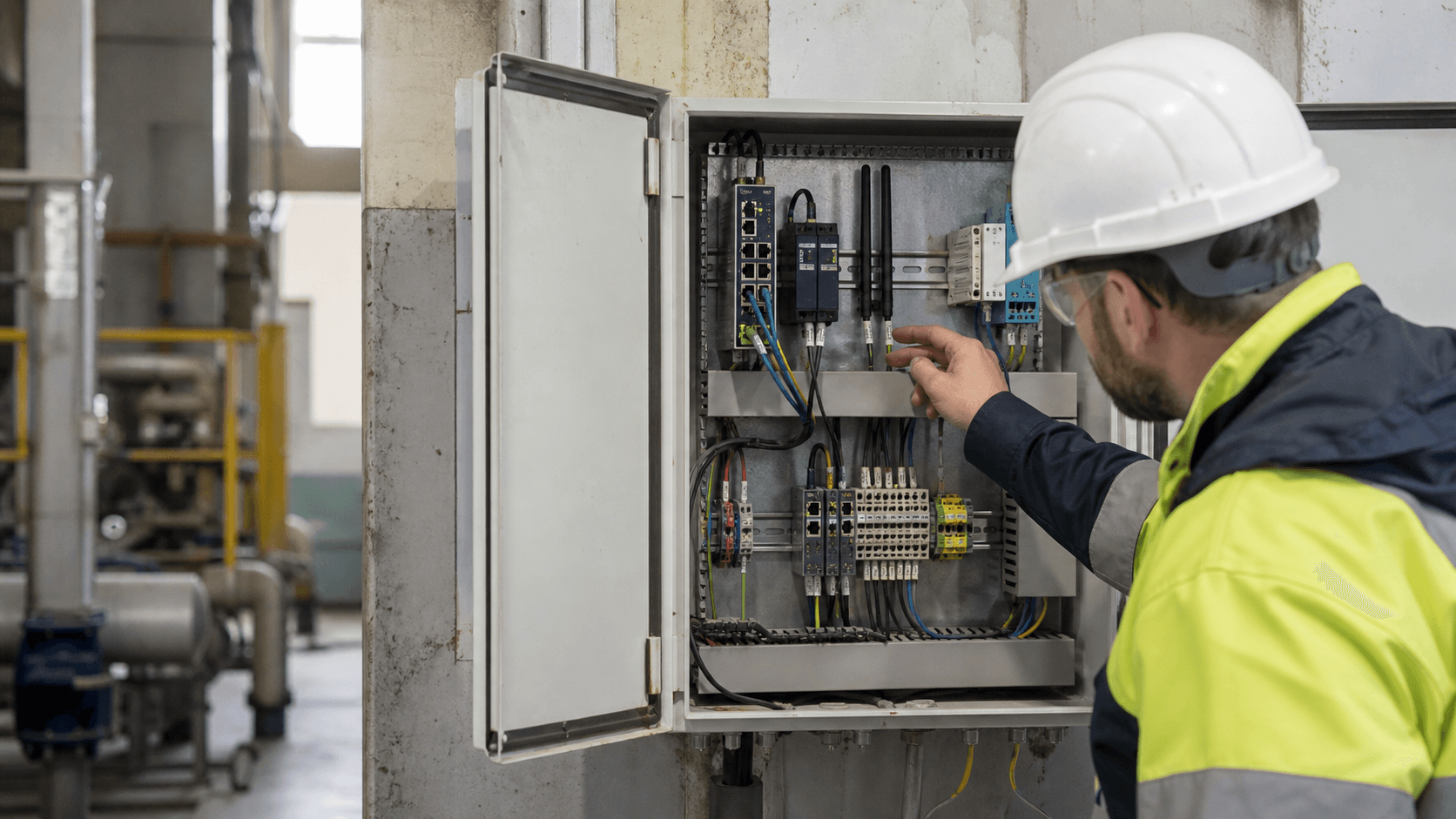
Finally, separate control from monitoring. Safety-critical or deterministic control should remain on an architecture designed and validated for that responsibility. An IoT connection can report status, history, and exceptions without becoming an unsafe replacement for the control network.
The Seven Questions That Shape the Choice
Coverage
Room, building, campus, city, or continuously mobile operation
Payload
A few bytes per event, periodic telemetry, files, audio, images, or sustained streams
Power
Coin cell, primary battery, rechargeable pack, vehicle power, or mains supply
Latency
Best effort, seconds, scheduled delivery, or near-real-time interaction
Mobility
Fixed sensor, movable asset, site vehicle, or roaming across regions
Ownership
Private infrastructure, public operator network, or a hybrid model
Lifecycle
Provisioning, credentials, subscriptions, firmware, diagnostics, and replacement
Technology Comparison
| Technology | Strength | Constraint | Typical role |
|---|---|---|---|
| BLE | Low-power local communication and broad phone support | Needs nearby receivers for continuous visibility | Tags, commissioning, wearables, local sensors |
| LoRaWAN | Long-range delivery of small, intermittent messages | Limited airtime, payload, and downlink capacity | Meters, environmental sensors, alarms, sparse tracking |
| Wi-Fi | High data rate on familiar local IP infrastructure | Power, credentials, roaming, and managed coverage | Powered devices, rich data, local applications |
| Cellular | Public wide-area coverage and mobility | Subscriptions, certification, coverage, and energy cost | Vehicles, remote assets, and multi-site equipment |
| Wired | Stable power, predictable links, established industrial protocols | Installation cost and limited mobility | Machines, panels, meters, controllers, fixed infrastructure |
When BLE Is the Practical Choice
BLE works well for devices that communicate locally and can rely on phones, fixed gateways, or locators. A small tag can advertise identity and sensor data without maintaining a continuous connection. A phone can commission a device or read it during service. Fixed receivers can provide presence, zone, or direction-finding observations for indoor asset tracking.
The coverage model must be explicit. “BLE range” is not a guaranteed site radius: walls, metal, people, antenna placement, transmit power, receiver sensitivity, and interference all matter. If every event must reach the platform, gateway placement and observation quality are part of the system design.
When LoRaWAN Fits
LoRaWAN is designed for low-power wide-area communication. It suits compact periodic or event-driven messages from sensors distributed across a campus, yard, farm, mine, utility network, or remote infrastructure. End devices can spend much of their time asleep while gateways forward received messages to a network server.
It is a poor fit for video, large files, frequent waveforms, or applications that assume unlimited immediate downlinks. Regional radio rules, gateway placement, message rate, payload, device class, retry strategy, and battery budget should be modeled together. See the LoRaWAN industrial IoT guide for the full architecture.
Reference: the LoRa Alliance developer overview covers the standards, regional parameters, certification, and network architecture.
When Wi-Fi or Cellular Wins
Wi-Fi is often sensible for powered devices inside managed facilities, especially when the workload needs more throughput than low-power radios provide. The difficult parts are operational: credential rotation, coverage at the installation point, network segmentation, roaming, security policy, and coordination with the site IT team.
Cellular is valuable when an asset moves beyond private infrastructure or when installing and managing site gateways is impractical. The design must account for the modem's transmit peaks, antenna placement, network availability, roaming, SIM or eSIM lifecycle, data plan, carrier changes, certifications, and the behavior of the device when coverage disappears.
Hybrid Architectures Are Normal
One radio can handle the local device relationship while another provides backhaul. A BLE tag may be heard by a LoRaWAN gateway. A machine can expose Modbus data to a gateway that publishes selected events over cellular. A Wi-Fi device may use BLE only for commissioning. A tracker may combine GNSS outdoors, BLE observations indoors, and cellular transport between sites.
Hybrid does not need to mean complicated. Each link should have one defined responsibility, a clear identity model, and testable offline behavior. Complexity becomes expensive when several radios duplicate each other without a documented decision rule.
Common Scenarios
Tools inside one facility
BLE tags with fixed gateways or locators
Low-cost tags and indoor presence or position workflows
Remote tank or meter
LoRaWAN
Small intermittent telemetry and long sleep periods across a large site
Powered camera or rich local device
Wi-Fi or Ethernet
High data volume where local infrastructure and power are available
Vehicles moving between sites
Cellular with GNSS
Wide-area mobility without relying on private gateway coverage
Existing machine interface
Wired field connection to an IoT gateway
Preserve proven sensors and industrial protocols while adding a secure application path
From Connectivity to Asset Operations
VAUTN can design the device, antenna, embedded firmware, power system, gateway path, provisioning flow, and cloud integration around the chosen workload. The goal is a supportable device fleet, not simply a successful radio demonstration.
AssetOptima provides the operational destination for useful events: movement, condition exceptions, maintenance evidence, device health, inspections, warranties, and asset history. The connectivity layer should deliver a small, stable event contract with identity, time, quality, and configuration context.
Choose Connectivity from Evidence
Model the real payload, power source, coverage, latency, infrastructure, and operating lifecycle before selecting hardware.
Discuss Your IoT Connectivityarrow_forward