
BLE Asset Tracking: How Tags, Gateways, and Indoor Positioning Work
Bluetooth Low Energy can make indoor assets easier to find, audit, and manage—but a beacon alone is not a tracking system. A useful deployment combines the right tag, a receiving network, a location method suited to the required accuracy, and software that turns radio observations into operational decisions. This guide explains each layer before showing how an end-to-end solution can be built.

What Is BLE Asset Tracking?
BLE asset tracking uses small Bluetooth transmitters attached to equipment, tools, containers, inventory, or personnel. A tag typically broadcasts a short advertising packet at a configured interval. Nearby receivers observe that packet and forward the observation to software that associates the tag identity with a real asset.
This is different from a barcode or QR code, which needs an intentional scan. It is also different from a GPS tracker, which calculates outdoor position and usually needs more power. BLE is strongest inside buildings, yards, workshops, hospitals, warehouses, and campuses where fixed receivers can provide coverage and where low tag cost and long service intervals matter.
The word “tracking” covers several outcomes. Some projects only need proof that an item is nearby. Others need room- or zone-level visibility. A smaller set needs a continuously estimated position. Defining that outcome first prevents a proximity system from being sold as precision location—or an expensive positioning system from being installed where a simple last-seen event would have been enough.
How the Tracking Chain Works
A reliable architecture separates radio observations from business records. That keeps the tag simple and allows location logic to improve without rewriting the asset-management system.
Tag or beacon
A battery-powered BLE device periodically advertises a unique identity and, when required, compact sensor or battery data. It does not need to hold the full asset record.
Gateway or locator
A phone, fixed gateway, or AoA locator receives the transmission and adds context such as time, receiver identity, signal strength, or direction-finding samples.
Location engine
Software filters duplicate observations and converts radio measurements into useful states such as present, absent, zone changed, last seen, or estimated position.
Business workflow
The resulting event is linked to an asset record, where teams can audit movement, investigate exceptions, coordinate maintenance, and measure utilization.
BLE Beacons and Bluetooth Mesh Are Not the Same Thing
Most asset tags use connectionless advertising: the tag broadcasts, and one or more gateways listen. This model keeps the tag simple and power-efficient. Bluetooth Mesh serves a different purpose. It provisions devices as nodes in a many-to-many network and allows selected powered nodes to relay messages across multiple hops using managed flooding or directed forwarding.
Mesh is useful for building controls, lighting, distributed sensors, and other systems where devices need coordinated communication beyond direct radio range. It is not automatically required for beacon tracking, and asking battery-powered asset tags to relay traffic can work against the power budget. A deployment may use beacons for asset identity while a separate gateway or wired network carries observations to the platform.
Technical reference: the Bluetooth SIG's Bluetooth Mesh Networking primer explains node roles, low-power nodes, managed flooding, and directed forwarding.
Three Levels of Indoor Location
Presence and last seen
The simplest method records which receiver recently heard a tag. It answers questions such as whether an asset is present at a site or was last observed near a store entrance. It is inexpensive and often sufficient for audits and missing-asset searches.
RSSI-based proximity and zones
Received Signal Strength Indicator (RSSI) provides a rough measure of how strongly a gateway hears a tag. Comparing observations and applying dwell-time rules can estimate near/far states or assign a likely zone. RSSI is not a ruler: walls, shelving, people, metal, antenna orientation, and reflections can all change the measurement.
Angle of Arrival positioning
Bluetooth Angle of Arrival (AoA)—sometimes mistakenly described as an “angle of attack” sensor—adds direction to the observation. A compatible tag transmits a direction-finding packet from a single antenna. A fixed AoA locator receives it through an array of antennas, switching between them and collecting in-phase and quadrature samples. Software uses the phase differences across the array to estimate the direction from which the signal arrived.
One locator provides an angle; observations from multiple well-positioned locators can be combined to estimate a two- or three-dimensional position. The result depends on antenna geometry, locator placement, calibration, ceiling height, line of sight, and multipath reflections. AoA can support far greater precision than RSSI zoning, but it requires compatible tags, antenna-array locators, a location engine, and a site survey.
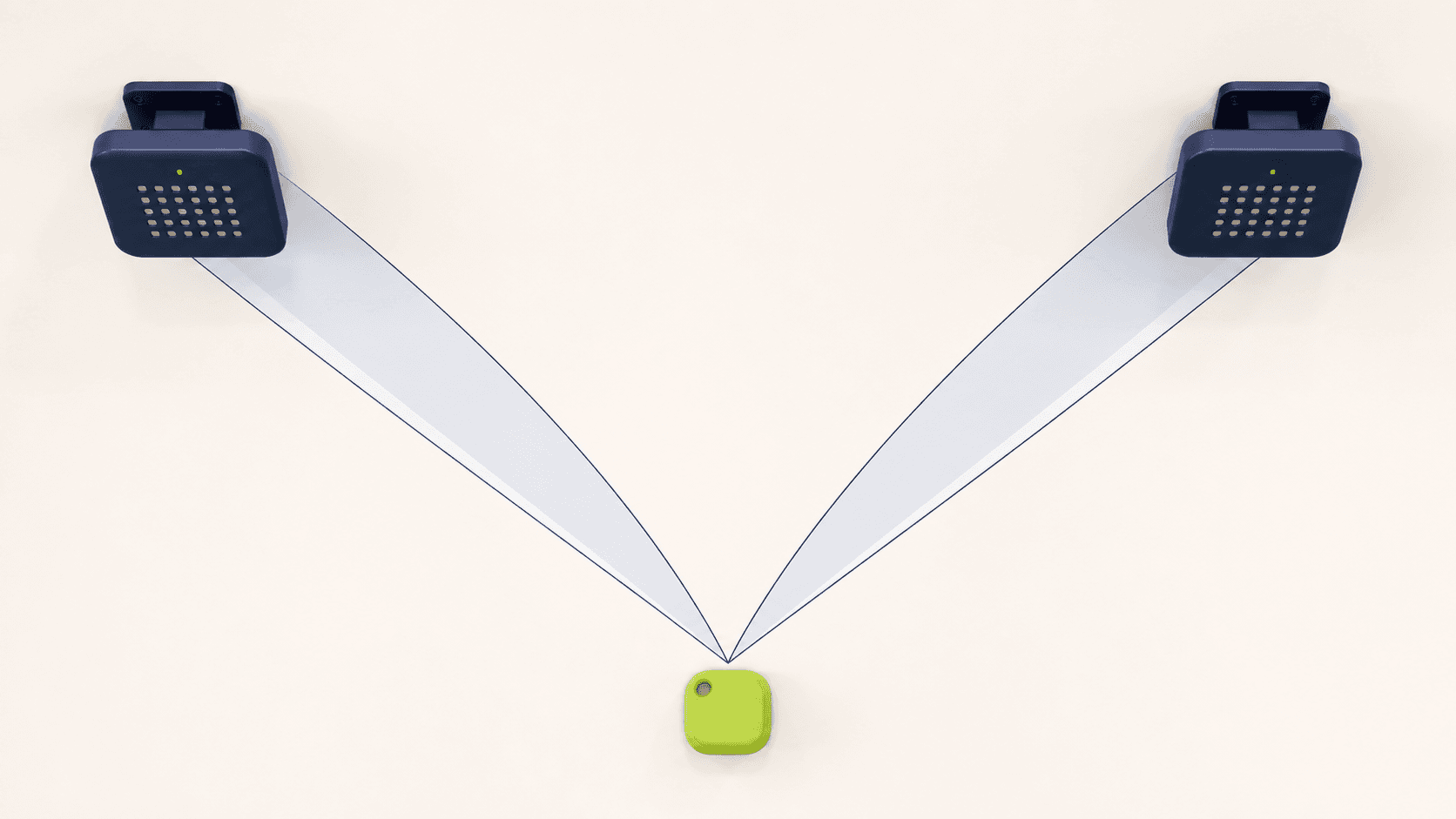
Technical reference: the Bluetooth SIG describes the single-antenna transmitter, receiving antenna array, and direction calculation in its Direction Finding overview.
BLE Tag Types and Size Possibilities
There is no single ideal tag enclosure. Size follows the battery, advertising interval, radio range, sensing features, mounting method, ingress protection, temperature range, and service-life target. The dimensions below are useful design envelopes rather than specifications for announced products.
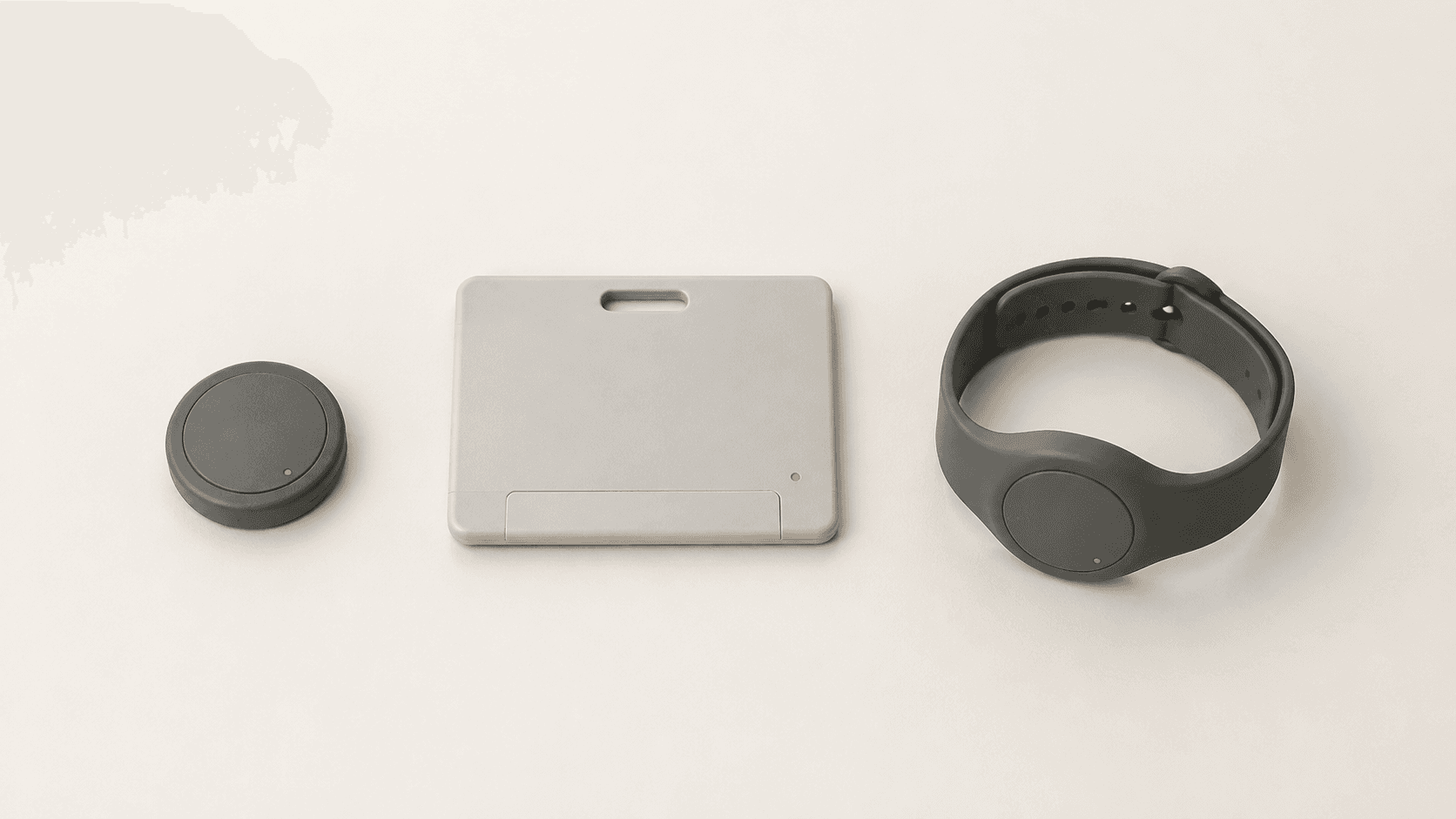
| Form factor | Typical design envelope | Good fit |
|---|---|---|
| Adhesive mini tag | About 25–40 mm across and 4–10 mm thick | Small tools, bins, cases, and high-volume deployments |
| Coin or puck tag | About 30–50 mm across and 8–18 mm thick | General equipment, returnable assets, and replaceable-battery designs |
| Key-fob or loop tag | About 35–60 mm long | Keys, tool sets, bags, and assets needing a cable-tie or ring attachment |
| Card or badge tag | Around an 86 × 54 mm card footprint; thickness depends on battery and controls | Personnel badges, visitors, contractors, and flat mounting areas |
| Wristband or helmet tag | Sized around the wearer or PPE attachment | Worker presence, safety workflows, and mustering |
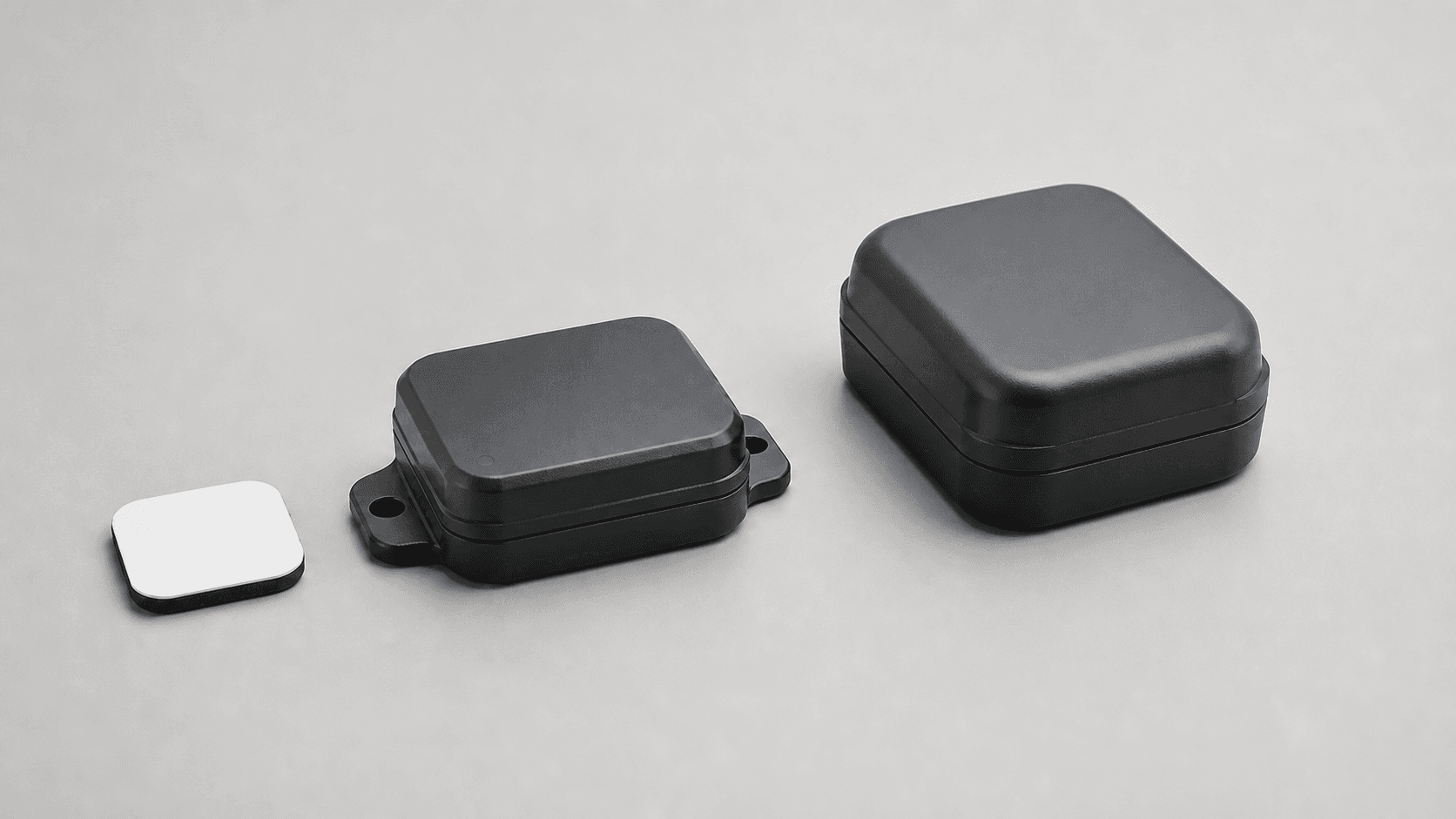
| Rugged industrial tag | Roughly 60–120 mm long and 15–35 mm deep | Vehicles, machinery, outdoor equipment, high-capacity batteries, or sensor inputs |
What Can Be Built into a Tag?
A basic tag may only advertise identity and battery state. Application-specific designs can add an accelerometer for movement and impact events, temperature and humidity sensing, ambient light for tamper or exposure detection, a button for assistance or workflow confirmation, an LED or buzzer for locating an item, or a contact input for monitoring a door or enclosure.
Every addition has a cost. More frequent measurements and transmissions consume energy. A larger battery increases size and weight. A sealed enclosure improves environmental protection but changes battery-replacement and manufacturing decisions. The right design starts from the workflow and maintenance model—not from the longest possible feature list.
Mounting is part of radio design. Adhesive, screws, rivets, magnets, cable ties, badge clips, wristbands, and helmet mounts all affect how the enclosure sits against the asset and how its antenna performs. Metal assets may require spacing or a purpose-designed antenna arrangement, which should be validated on the actual equipment.
From Location Events to Asset Workflows
| Operational need | BLE signal | Asset-management action |
|---|---|---|
| Faster physical audits | Last seen in the expected zone | Prioritize missing or unexpected assets for manual verification |
| Movement control | Arrival in or departure from a defined area | Record a movement event or route an exception for approval |
| Tool and equipment availability | Recent presence at a store, bay, or work area | Show operational context alongside assignment and status |
| Maintenance coordination | Asset detected at a workshop or service zone | Give the service team the asset record, open work, and maintenance history |
| Tag health | Reported low battery or missing observations | Create a follow-up task before tracking coverage is lost |
These workflows should be exception-led. Repeated radio observations do not need to become repeated asset transactions. The location layer can apply dwell times, confidence thresholds, and duplicate suppression so the operational system receives a meaningful event rather than a stream of radio noise.
Building a Cohesive Solution with VAUTN and AssetOptima
After the technology and accuracy target are clear, the physical and software layers can be designed together. VAUTN can provide the connected-device layer: application-specific tag and locator electronics, enclosure and mounting design, embedded firmware, gateways, device communication, and cloud integration.
AssetOptima provides the operational context around each asset: identity, assignment, location, movement history, physical audits, documents, warranties, contracts, depreciation, maintenance, inventory, procurement, and quality workflows. A defined API or webhook contract can map a tag identity and location event to the correct asset record.
That combination reduces hand-offs between a tag supplier, gateway vendor, cloud provider, and asset-software team. It also allows choices such as advertising interval, battery size, gateway placement, event rules, and approval workflow to be tested against the same operational outcome.
Start with a Site Pilot
A practical pilot selects representative assets, two or three meaningful zones, and a small set of decisions the data must support. The team surveys the radio environment, tests mounting options, measures missed observations and false zone changes, and establishes what happens when a gateway or tag is offline.
For AoA, the pilot also validates locator geometry, antenna-array placement, calibration, and performance around metal and moving obstructions. Once event quality is proven, the architecture can expand by asset class, site, and workflow with known coverage and maintenance assumptions.
Frequently Asked Questions
How accurate is BLE asset tracking?
It depends on the method. Presence and RSSI systems are best treated as proximity or zone estimates. AoA uses antenna arrays and multiple angles to support much finer positioning, but site layout and calibration still determine real performance.
Does every BLE tag work with AoA?
No. The tag, locator, controller, firmware, and location engine must support the required Bluetooth direction-finding features and packet format.
How long does a tag battery last?
There is no responsible single answer. Battery chemistry and capacity, transmit power, advertising interval, sensing, temperature, connection behavior, and expected coverage all affect service life. It should be modeled and then measured with the intended configuration.
Can BLE tracking integrate with an existing asset register?
Yes. The stable integration point is the mapping between tag identity and asset identity, followed by a small event contract for observations, zone changes, device health, and confidence. This is the role the VAUTN and AssetOptima integration is designed to address.
Plan a BLE Asset Tracking Pilot
Define the accuracy, tag, gateway, integration, and asset workflow as one practical system.
Discuss Your Tracking Requirementsarrow_forward