
Industrial IoT Gateways: How Sensors, Edge Processing, and Cloud Systems Connect
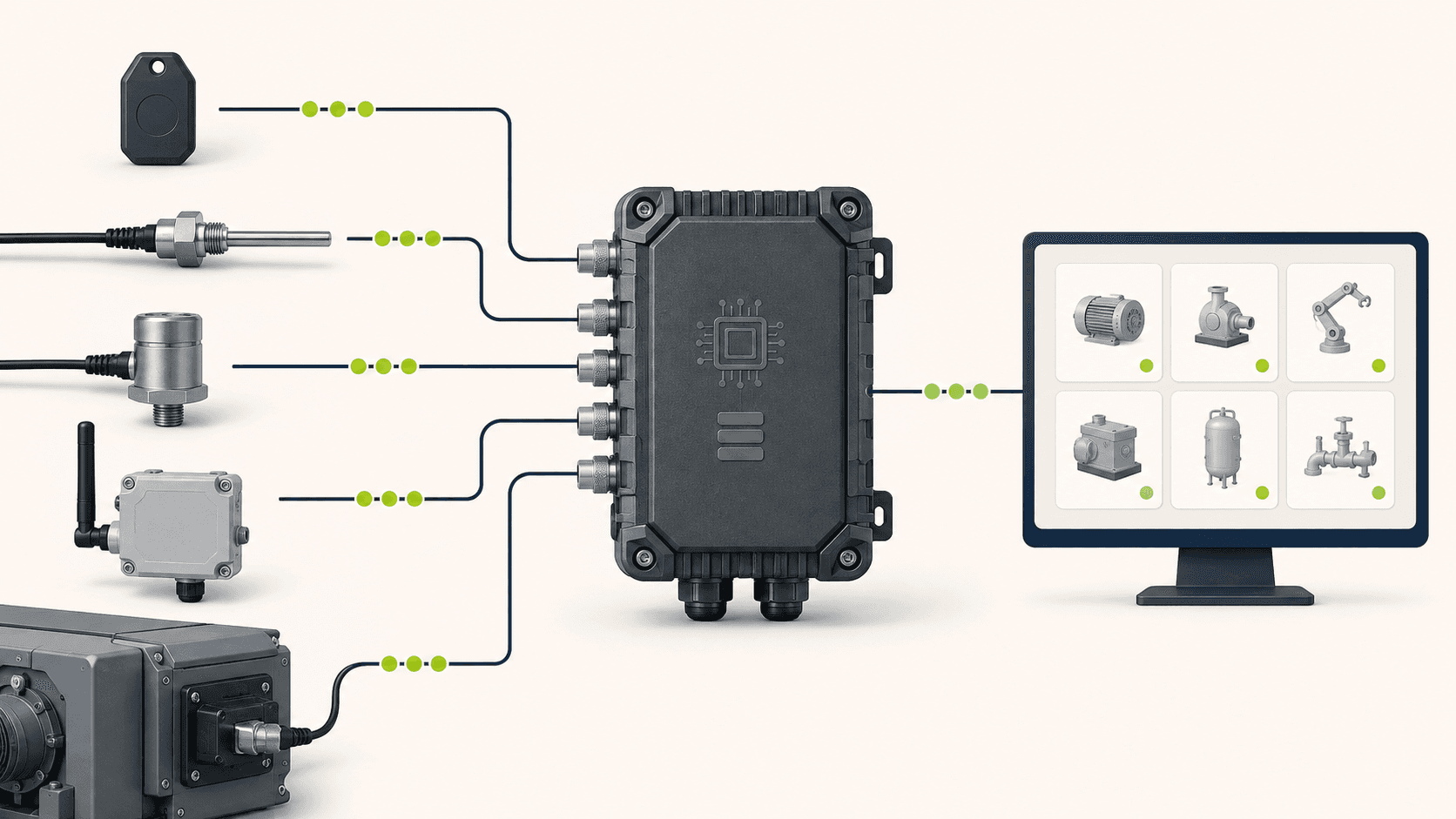
An industrial IoT gateway sits between field devices and the systems that use their data. It may listen for BLE tags, collect LoRaWAN packets, read a Modbus meter, buffer events during an outage, translate payloads, and deliver a consistent message upstream. The gateway becomes valuable when it reduces complexity at the device edge without hiding how identity, time, quality, and failures are handled.
Why Use a Gateway?
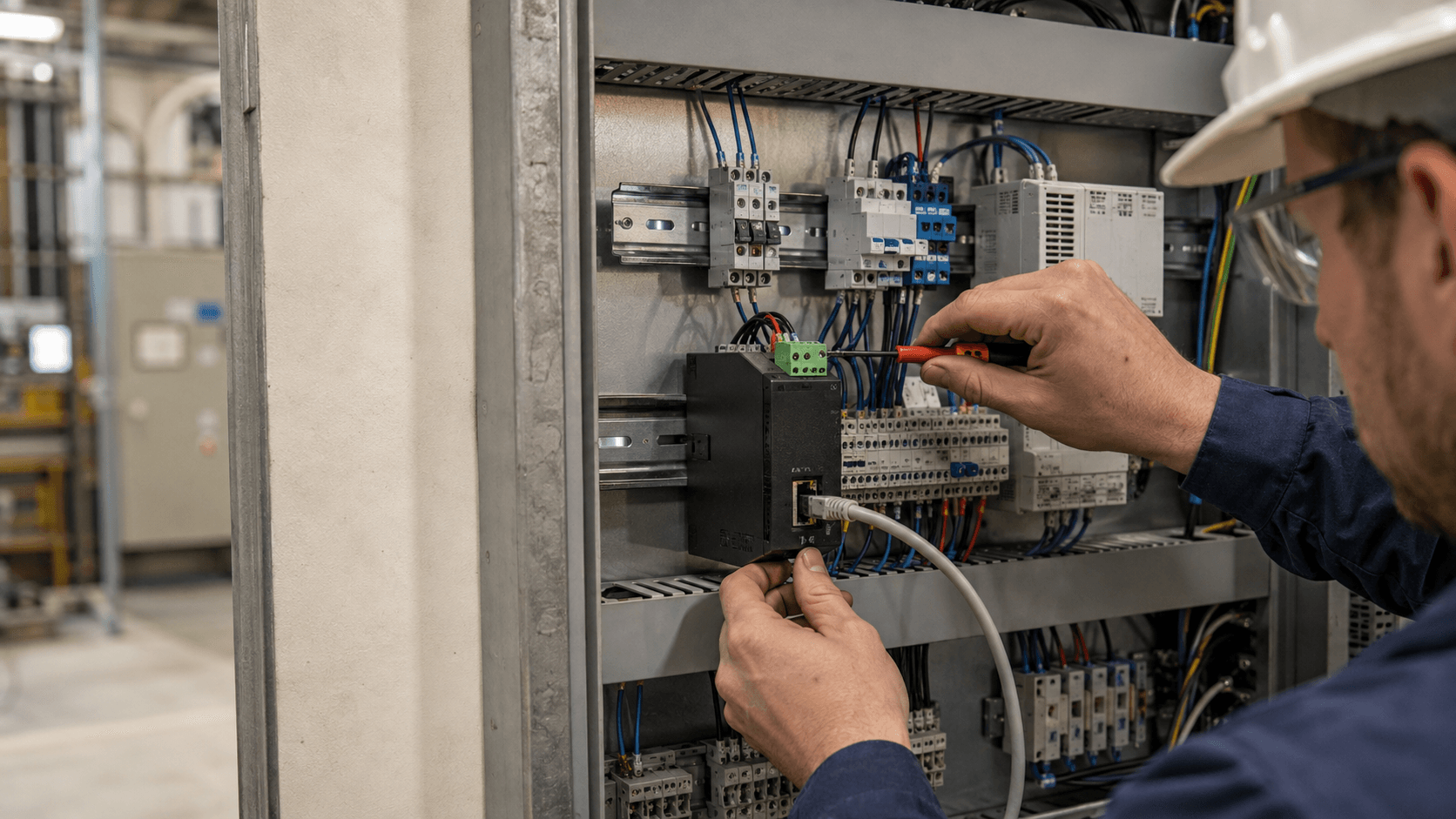
Small field devices often have limited power, memory, storage, and security capabilities. Existing machines may expose serial registers or dry contacts rather than MQTT or HTTPS. Sites may also prohibit direct internet access from operational equipment. A gateway provides a controlled place to bridge these constraints.
That does not mean every design requires one. A cellular tracker may connect directly to a cloud endpoint. A Wi-Fi device with adequate resources can authenticate and publish on its own. A gateway is justified when local aggregation, protocol support, isolation, offline buffering, edge processing, or shared backhaul produces a clearer and more supportable architecture.
Microsoft's current IoT architecture overview distinguishes cloud-connected devices from edge-connected and protocol-specific devices that use nearby gateways or connectors.
Six Jobs an Industrial Gateway Can Perform
Device aggregation
Collect observations from many local sensors, tags, meters, or controllers through one managed connection.
Protocol translation
Bridge device-side protocols to application-facing messaging without forcing every endpoint to speak an internet protocol.
Normalization
Convert vendor payloads, register maps, units, timestamps, and quality states into a stable event contract.
Store and forward
Buffer selected data during an upstream outage and deliver it safely when connectivity returns.
Edge rules
Filter noise, calculate features, apply thresholds, and support local actions where latency or bandwidth requires it.
Fleet operations
Expose gateway health, logs, configuration, certificates, software versions, and remote update status.
The Data Path
- Observe. A driver or radio service receives a reading, advertisement, register value, or field event.
- Identify. The gateway associates the message with a provisioned device, interface, asset mapping, and configuration revision.
- Validate. Length, type, range, timestamp, sequence, checksum, and quality rules reject or mark suspect data.
- Normalize. The raw payload becomes a stable record with units, event time, receive time, source, and quality context.
- Decide. Local rules may filter duplicates, calculate features, or create an exception while preserving required evidence.
- Deliver. The gateway publishes upstream, records acknowledgement state, and retains data that must survive an outage.
Raw and normalized data should not be confused. Keeping a bounded raw record can help diagnose decoder or firmware problems, while applications should consume a versioned contract. That separation allows a payload decoder to change without silently rewriting the meaning of historical business events.
Transparent, Protocol-Translation, and Identity-Translation Patterns
| Pattern | Gateway responsibility | Identity upstream |
|---|---|---|
| Transparent | Routes authenticated downstream connections without changing application messages | Each downstream device retains its own identity |
| Protocol translation | Converts a local protocol or payload into an upstream protocol | May be the gateway or the original device, depending on the contract |
| Identity translation | Represents constrained downstream devices and manages their cloud-facing identity relationship | A distinct mapped identity is maintained per downstream device |
These patterns can coexist, but the identity decision must be deliberate. If every event appears to come from the gateway, authorization and diagnostics become simpler at first but asset-level traceability may be lost. If every endpoint has a first-class identity, provisioning and credential operations become more demanding but access and audit boundaries can be clearer.
BLE, LoRaWAN, Wired, and Hybrid Gateways
A BLE gateway listens for advertisements or maintains selected connections, adds receive time and signal context, and forwards observations. For asset tracking, several gateways or antenna-array locators may feed a location engine rather than independently deciding where an asset is.
A LoRaWAN gateway forwards radio packets between end devices and the network server. Application decoding, device session management, deduplication, and network policy belong at defined layers; the radio gateway should not be mistaken for the complete LoRaWAN platform. The LoRaWAN guide explains that separation.
A wired gateway may poll Modbus, receive CAN frames, count pulses, or read isolated digital and analog inputs. A hybrid gateway can combine these interfaces with BLE, LoRaWAN, Wi-Fi, Ethernet, or cellular backhaul. Each additional interface increases enclosure, antenna, EMC, power, firmware, and test complexity, so it should support a real deployment need.
Offline Behavior Is a Product Requirement
Upstream connectivity will fail. The design must state what is buffered, for how long, in what order, and what happens when storage fills. Alarm events may take priority over routine telemetry. Some applications require every sample; others only need exceptions and summary statistics.
Store-and-forward also needs duplicate and ordering rules. An application should know the event time separately from the time it finally arrived. Idempotency keys or sequence information prevent a replayed batch from creating duplicate work orders or repeated movement transactions.
Local actions need an explicit safety boundary. A gateway can trigger a notification, switch a non-critical output, or maintain a local schedule where appropriate. It should not be assigned a safety or deterministic-control role without the hardware, software, validation, and operating process required for that responsibility.
Security and Remote Management
A gateway bridges trust zones and is therefore a security boundary. Secure boot, signed software, protected credentials, least-privilege services, encrypted upstream communication, firewall policy, restricted administration, audit logs, and a vulnerability-response process are practical requirements—not optional cloud features.
Fleet operations need device identity, certificate rotation, configuration history, health metrics, storage status, service logs, update rollout, rollback or recovery behavior, and ownership transfer. An unreachable gateway should create an actionable operational state with enough context to distinguish site power, upstream network, application, and hardware failures.
Hardware and Installation Checklist
Interfaces
BLE, LoRaWAN, Ethernet, Wi-Fi, cellular, RS-485, CAN, digital or analog I/O as the application requires
Compute and storage
Enough margin for protocol services, buffering, logs, updates, certificates, and future security maintenance
Power
Input range, surge protection, isolation, brownout behavior, backup strategy, and graceful shutdown
Environment
Temperature, ingress, dust, vibration, condensation, EMC, installation clearances, and service access
Mounting and antenna
DIN rail, wall, pole, panel, antenna separation, ground plane, cable loss, and replaceable connections
A Cohesive VAUTN and AssetOptima Architecture
VAUTN can develop gateway electronics, interface protection, radio and antenna systems, embedded Linux or firmware services, device drivers, local storage, secure communications, enclosures, provisioning, and deployment tooling. VAUTN Cloud can provide authenticated ingestion, device health, configuration, APIs, webhooks, and multi-tenant services.
AssetOptima supplies the operational context that a gateway does not have: the asset, owner, location, work order, maintenance plan, warranty, inspection, procurement, and lifecycle record. Mapping a versioned gateway event to that context creates an end-to-end solution while keeping radio traffic and business transactions appropriately separated.
Design the Gateway as an Operated Product
Plan interfaces, identity, buffering, security, updates, installation, and asset workflows before scaling the site.
Discuss Your Gateway Requirementsarrow_forward